
“Freethought, as Richard Scholar demonstrates in his study of Montaigne, is a finely balanced relationship between three essentials: the freedom to reject the authorities of the past including one’s own teacher; the careful use of doubt as a means of searching for truth, including doubt about one’s own position; and employing ‘constraints’ when necessary. “
From Ziauddin Sardar
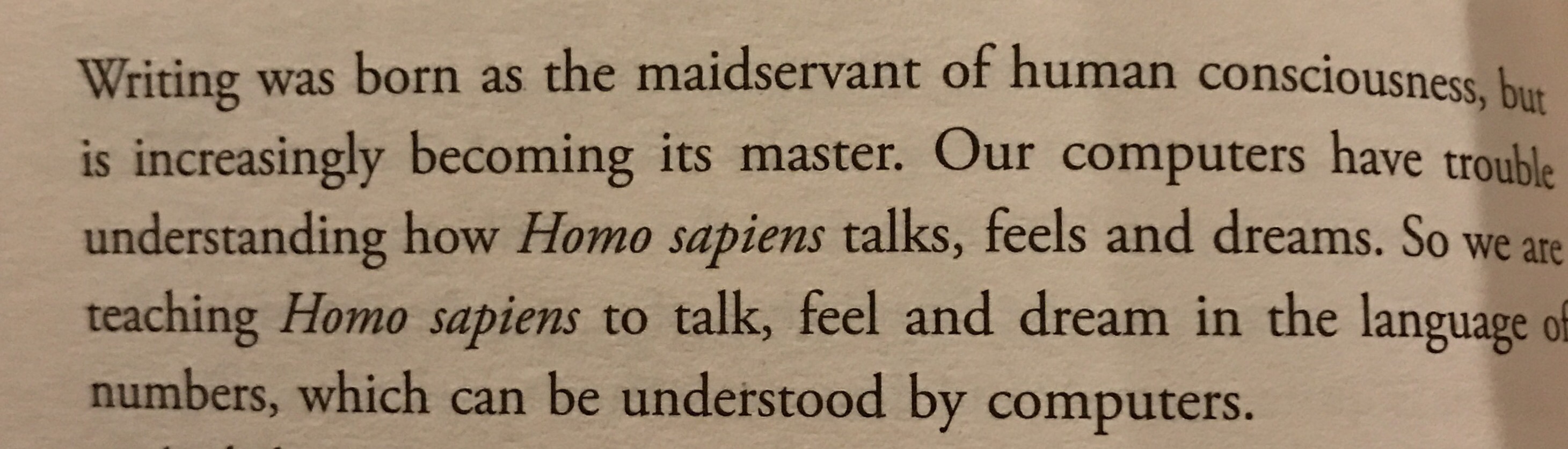
Sapiens!
 Yuval Noah Harari
#consciousness #artificialintelligence #history
“Most of the creations of the intellect or fancy pass away for good after a time that varies between an after-dinner hour and a generation. Some, however, do not. They suffer eclipses but they come back again, and they come back not as unrecognizable elements of a cultural inheritance, but in their individual garb and with their personal scars which people may see and touch. These we may well call the great ones—it is no disadvantage of this definition that it links greatness to vitality. Taken in this sense, this is undoubtedly the word to apply to the message of Marx.”
from “#Capitalism, #Socialism, and #Democracy” by Joseph #Schumpeter
“Nineteenth-century social theory—exemplified in the works of Marx and Weber—teaches us that two great forces have shaped the modern world: the rise and domination of capitalism and the seemingly inexorable rise and power of the bureaucracy. Marx accurately predicted that capitalism would penetrate all corners of the world economy, and Weber gloomily predicted that mankind would be trapped in an “iron cage of his own making from which he could not escape”—and the iron cage was the bureaucracy.” from “Why Should Anyone Work Here?: What It Takes to Create an Authentic Organization” by Rob Goffee, Gareth Jones
#socialtheory #economics #anthropology
““I like to turn things upside down, to watch pictures and situations from another perspective . . . [and] see how things behave if you change the point of view.” —Ursus Wehrli. Swiss comedian and artist” from “The Silo Effect: The Peril of Expertise and the Promise of Breaking Down Barriers” by Gillian Tett
Law & Politics..
In a lecture published in 1882 entitled “The History of English Law as a Branch of Politics,” the English jurist Sir Frederick Pollock wrote that “law is to political institutions as the bones to the body (Pollock 1882: 200-1)”.
(Horowitz 1977b: 151). Thus, he continues:
“Courts are public decision makers, yet they are wholly dependent on private initiative to invoke their powers: they do not self-start. Parties affected by administrative action choose to seek or not to seek judicial redress on the basis of considerations that may bear no relation to the public importance of the issues at stake, to the recurring character of the administrative action in question, or to the competence of courts to judge the action or change it.”
Variants of Horowitz’s arguments are echoed by many other writers, including the American Lon Fuller (1978) and the English administrative lawyer Peter Cane (1986). Cane argues that:
“Because judicial proceedings are essentially bipolar, they are designed to resolve disputes in terms of the interests of only two parties or groups represented by those parties. And, because judicial proceedings are adversarial, disputes are to be decided only on the basis of material which the parties choose to put before the courts. If the problem is one which is felt to require, for its proper resolution, the consideration of interests of parties not before the court and not in formal dispute with one another, of persons who will be affected consequentially or incidentally by any resolution of the dispute between the parties, then a court is not the ideal body to resolve that dispute (Cane 1986: 149).”
#judicialactivisim #judiciary #legislative
. A New Handbook of Political Science (Kindle Locations 2385-2386). Kindle Edition.
 Muhammad Ali Chaudhry